




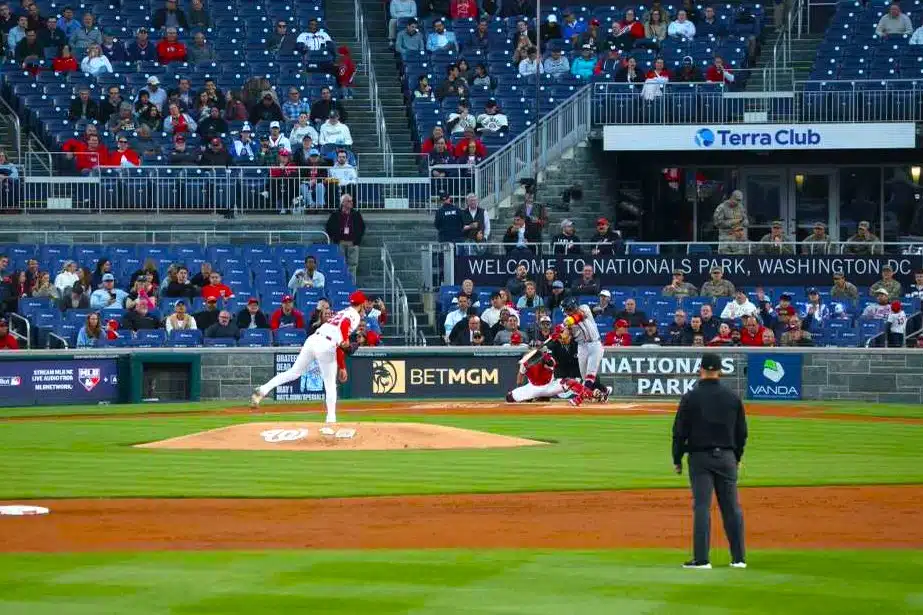


There was a private party for stadium workers last night at Nationals Park. Nobody knew that their bartender was going to be the President of Baseball Operations, Mike Rizzo, and the newly retired bullpen ace of the 2019 season, Sean Doolittle, was going to pose for photos and sign autographs. They graced these employees with their presence. Or is that presents? We posted up some photos that were sent to us with the condition of anonymity — and then word spread and other employees were sending us videos, photos, and stories. These are the little things.
Usually, these are the types of stories you never hear about because positivity doesn’t get you the clicks like the negativity. You learn that in new journalism in the social media era. Journalism changed. Go viral! I just heard it last week on Apple TV’s The Morning Show. If you want negativity, you can dig it up easily. Stir up those old emotions — and pick at the scabs. The triggers are there to tie everything right back to the powder keg — the evil ownership group is what they will keep telling you is the root of all problems. No blame is assessed to the people who did not get their job done — no, the problem is the boss of their boss or the boss two or three levels above.
They did the same when Dusty Baker was not retained after the 2017 season. You were convinced that the move was motivated by saving money because Dave Martinez was taking the job for millions less than Baker. Never mentioned by them was that there were key players who did not want Baker back. It was just another PR nightmare for the team. All roads, they tell you, lead back to the Lerner ownership group and their greed. That is the underlying message even though they don’t say those exact words. Make everything about money, and start a movement to force them to sell the team. The words twisted and turned enough doesn’t need a genius to get you there. I read it enough yesterday in social media tweets that got so ridiculous that the Nats were compared to the lowly Oakland A’s.
Continue reading


We recently upgraded our comment system to improve reliability, performance, and long-term control, and we’re currently running both systems during the transition. This shift moves us away from an external service to a system we run and control directly—meaning we own the content and can continue improving it over time. We’ve also reduced the comment refresh delay from about 30 seconds to 10 seconds, making it much closer to real-time.
We understand there have been frustrations and increased feedback, and we’re actively working to improve things. What we ask is simple: use the system and give it a fair shot. If you run into issues, please submit them through the support form so we can track and fix them properly. Repeated complaints without details don’t help us solve problems—we appreciate your patience as we continue refining the experience.
If you’d like a full side-by-side comparison of the platforms and the reasons behind this decision, please refer to the chart below. This change is being made with the long-term benefit of the entire community in mind.